Alpha Digital, LLC
Every Digital Ecosystem gets stronger with every new customer — but only if it can learn from those customers.
Inside the Alpha Digital Ecosystem, tracking and analytics are not reporting tools. They are the data brain — the intelligence layer that allows the entire system to adapt, optimize, and scale predictably.
Without clean data, growth becomes guesswork. With clean data, growth becomes intentional.
Why Data Is the Brain of the Digital Ecosystem
Every layer of the ecosystem depends on accurate information.
- Ads rely on conversion signals
- Lifecycle marketing relies on behavioral data
- CRO relies on user journey insights
- Strategy relies on truth
If the data is inaccurate, delayed, or incomplete, the entire ecosystem suffers. Decisions become emotional. Optimizations miss the mark. Scaling feels risky instead of controlled.
This is why tracking is foundational — not optional.
GA4’s Role Inside the Ecosystem
Google Analytics 4 is the core reporting and intelligence platform inside the ecosystem, but GA4 alone is not enough unless it’s configured correctly.
Default Shopify tracking provides surface-level data. The Digital Ecosystem requires precision.
Inside the Alpha Digital Ecosystem, GA4 is configured to accurately track:
- Product views
- Add-to-cart events
- Checkout progression
- Purchases and revenue
- Customer behavior across sessions
- Engagement across devices
This turns GA4 into a true source of truth, not an approximation.
Clean Events Create Clear Decisions
The ecosystem is only as smart as the events it receives.
Clean event tracking allows the system to answer critical questions:
- Where are users dropping off?
- Which products convert best?
- Which traffic sources drive real customers?
- Which actions lead to repeat purchases?
- Where should optimization efforts focus next?
When these answers are clear, every other system becomes more effective.
Attribution: Connecting Cause and Effect
Attribution is where many ecosystems break down.
If ads, analytics, and platforms don’t agree on what caused a purchase, optimization becomes impossible. That’s why attribution is treated as part of the data brain, not a separate problem.
Inside the Digital Ecosystem:
- GA4 provides behavioral truth
- Ad platforms receive consistent conversion signals
- Revenue aligns across systems
- Decision-making becomes confident instead of reactive
This alignment allows scaling without losing visibility.
Server-Side Tracking: Protecting the Brain
Modern privacy changes, browser restrictions, and ad blockers have weakened traditional client-side tracking.
Server-side tracking is the evolution of the data brain.
By moving key tracking events server-side, the ecosystem:
- Preserves conversion accuracy
- Reduces signal loss
- Improves attribution reliability
- Maintains performance long-term
This ensures the ecosystem continues learning even as the digital landscape changes.
The Data Layer: Structuring Intelligence
The data layer is the organizing system behind tracking.
It structures:
- Customer actions
- Product interactions
- Revenue events
- User states
This structure allows GA4, Klaviyo, ad platforms, and CRO tools to speak the same language.
When systems share structured data, optimization becomes faster and more precise.
How the Data Brain Strengthens the Entire Ecosystem
This is where the compounding effect becomes clear.
Accurate data:
- Improves audience quality for acquisition
- Strengthens lifecycle segmentation
- Makes CRO tests more reliable
- Increases confidence when scaling spend
- Reduces wasted effort
Each improvement in the data brain spreads outward into every other layer of the ecosystem.
Better data doesn’t just improve reporting — it improves outcomes.
Data Turns Growth From Reactive to Predictable
Without a data brain:
- Scaling feels risky
- Decisions rely on instinct
- Problems are discovered too late
With a data brain:
- Opportunities are visible early
- Bottlenecks are identified quickly
- Growth becomes measured and controlled
This is the difference between chasing performance and engineering it.
The Data Brain in Action
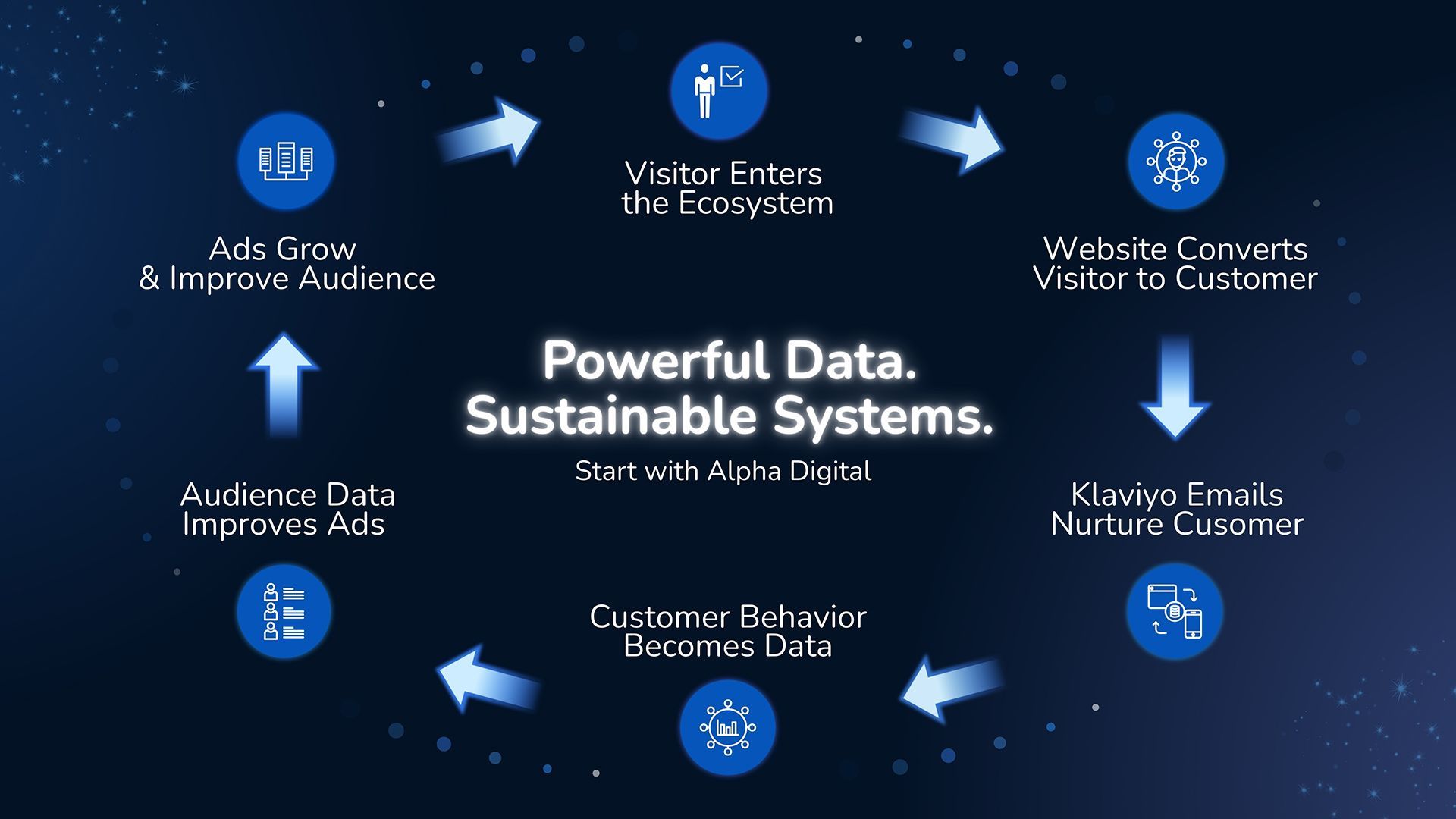
Inside the Digital Ecosystem, the loop looks like this:
- A customer enters the ecosystem.
- Their behavior is tracked accurately.
- That behavior becomes structured data.
- The data informs ads, lifecycle, and CRO.
- Those improvements attract better customers.
- Better customers create better data.
Each cycle strengthens the next.
This is how the ecosystem learns.
Why Most Brands Struggle With Tracking
Most brands don’t struggle because they lack tools — they struggle because their tools aren’t connected.
The Digital Ecosystem solves this by making data a system, not a collection of reports.
Final Thoughts
Growth doesn’t come from more data. It comes from better data.
When tracking is accurate, structured, and connected, the ecosystem becomes intelligent. And when the ecosystem is intelligent, scaling stops being chaotic and starts being predictable.
This is why GA4, tracking, and the data brain sit at the center of the Alpha Digital Ecosystem — because everything else depends on it.
Let's Talk
Contact Us